
LAW OF EQUAL PAY AND REMUNERATION CRITERIA BETWEEN WOMEN AND MEN
Updated: April 6, 2026
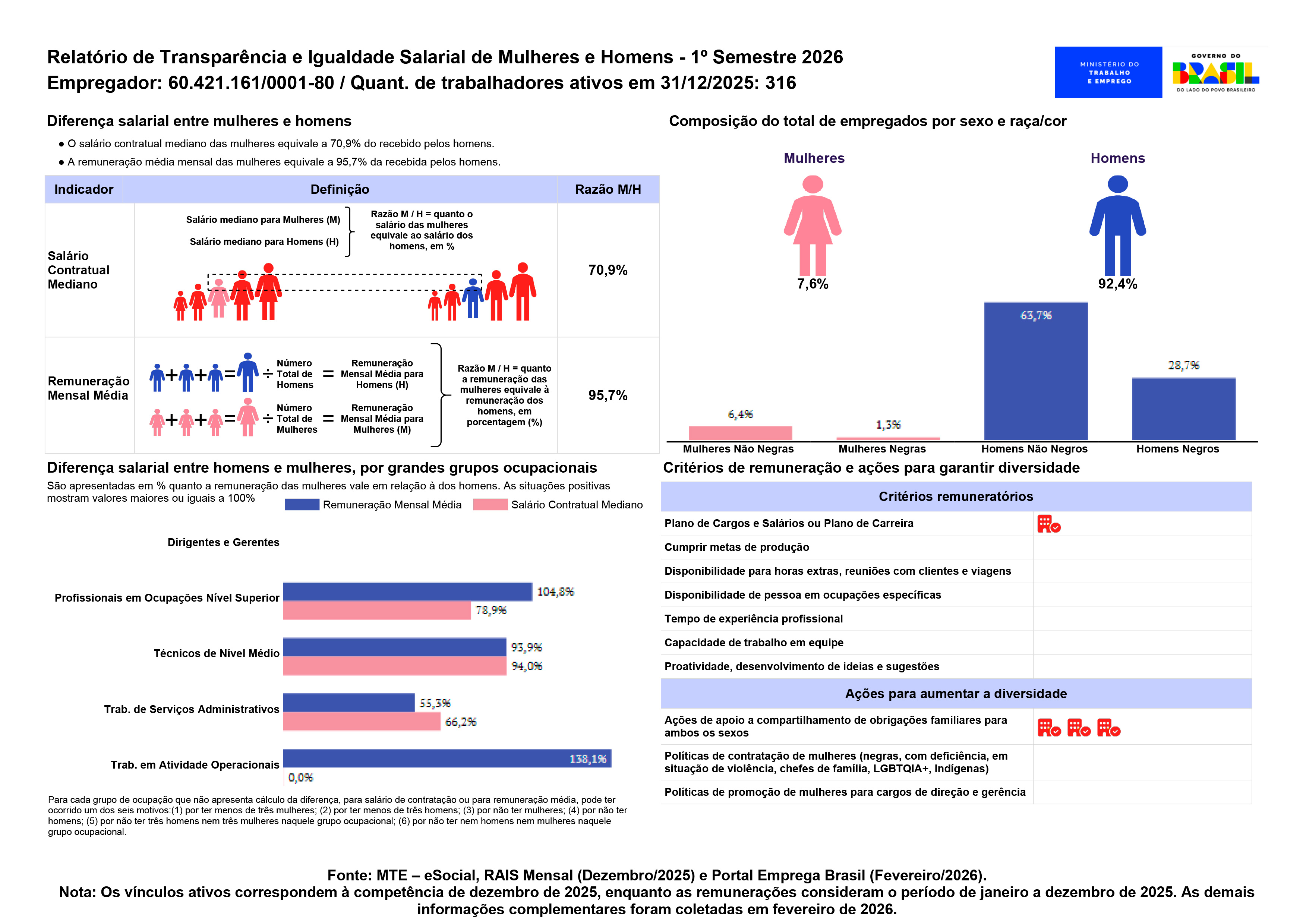
We hereby announce the publication of the Transparency and Equal Pay Report, prepared by the Ministry of Labor and Employment (MTE), under Law No. 14,611/2023, MTE Ordinance No. 3,714/2023 and Decree No. 11,795/2023.
The report is periodically reviewed by the MTE and aims to promote transparency regarding equal pay and compensation criteria between women and men.
It is important to highlight that the report is based on aggregated and extensive data, such as the Major Groups of the Brazilian Classification of Occupations (CBO), as well as on information declared to eSocial and RAIS. For this reason, the data contained therein does not necessarily reflect the current situation of the company.
At Cocam, we reaffirm that men and women receive equal salaries for the same function and position, in accordance with our institutional commitments to diversity, equity and inclusion.
Periods (Emprega Brasil files):
EXPLANATORY NOTE
This report meets the aforementioned legal requirements and is based on the following databases:
1. Brazilian Classification of Occupations (CBO) – Established by Ordinance No. 397/2002, the CBO is a major and generic classification of professions in the labor market, intended to support accessory obligations, such as eSocial, and to assist in identifying the positions used by companies.
2. Salary and remuneration information declared by companies to eSocial and RAIS, with data related to the fiscal year 2022 to 2024.
The information was organized by the MTE based on the Major Groups of CBO, which consolidate various occupations under the same classification. We therefore reiterate that this structure does not reflect the specific reality of Cocam's job and function structure.
The report is presented in an anonymized format, as provided for in Law No. 13,709/2018 (General Personal Data Protection Law – LGPD), and includes comparisons between salaries and job occupancy by gender, in compliance with the current legislation.